
💡 Laser vs. EMTT: Which Therapy Delivers Deeper Healing?
Introduction: Two Cutting-Edge Tools, One Common Goal
In the evolving world of regenerative medicine and pain management, two technologies have stood out for their non-invasive yet powerful ability to stimulate healing: Laser Therapy and Electromagnetic Transduction Therapy (EMTT). Though both are used to promote cellular repair, reduce inflammation, and relieve chronic pain, they work through very different mechanisms. Understanding their differences can help clinicians and patients alike determine the most effective solution depending on the tissue, diagnosis, and functional goal. Its effect on nerve function specifically is described in how EMTT reactivates nerve function.
This comprehensive guide explores both modalities, their unique mechanisms, therapeutic applications, and how they can be used independently or in combination to support optimal healing in musculoskeletal care.
🔬 The Science Behind Laser Therapy
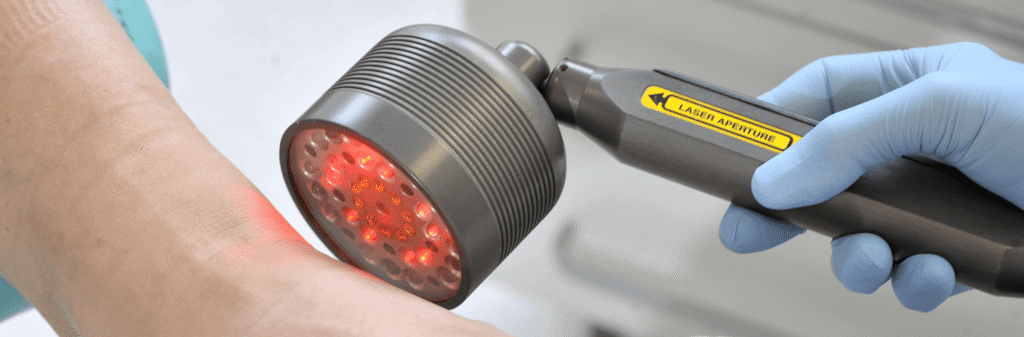
Laser Therapy, often referred to as Low-Level Laser Therapy (LLLT) or Cold Laser, uses specific wavelengths of light to penetrate soft tissues and stimulate mitochondrial activity. By targeting cytochrome c oxidase, laser energy accelerates ATP production, improves blood flow, and reduces oxidative stress at a cellular level.
Mechanisms of Action:
- Photon absorption by mitochondria
- ATP synthesis stimulation
- Enhanced microcirculation
- Anti-inflammatory cytokine release
Typical Indications:
- Tendonitis and bursitis
- Neuropathic pain
- Muscle strains
- Post-operative healing
Laser therapy is frequently used in early-stage rehabilitation where localized inflammation, pain sensitivity, or nerve irritation limit more aggressive physical therapy.
🌐 Understanding EMTT: Cellular Stimulation Through Magnetics
EMTT, Electromagnetic Transduction Therapy, is a more recent innovation that uses high-energy magnetic fields to influence cellular signaling and ion exchange at a deeper level. Unlike Laser, which acts on mitochondria directly via light, EMTT acts through mechanical electromagnetic stimulation that affects cell membrane permeability and enhances mitochondrial response over a larger volume.
Mechanisms of Action:
- Magnetic field-induced ion transport
- Mechanical stimulation of cell membranes
- Enhanced calcium and oxygen flow
- Tissue regeneration activation
Typical Indications:
- Bone and cartilage degeneration
- Chronic tendon disorders
- Joint inflammation and arthrosis
EMTT is particularly effective in subacute to chronic conditions where deeper tissue activation is needed, especially when standard therapies stall.
⚙️ Key Differences Between Laser and EMTT
| Parameter | Laser Therapy | EMTT Therapy |
|---|---|---|
| Type of Energy | Light (Photonic) | Magnetic Field (Electromagnetic) |
| Penetration Depth | Up to 5 cm (depending on wavelength) | Up to 18 cm |
| Target | Mitochondria, superficial tissues | Cell membranes, deeper tissue structures |
| Mechanism | Photochemical | Electromechanical |
| Treatment Duration | 5–15 minutes per area | 10–20 minutes per session |
| Clinical Sensation | Warmth or tingling | Mild tapping or vibration |
| Safety Profile | Excellent | Excellent |
💪 When to Choose Laser, EMTT, or Both
Laser Therapy is ideal when:
- Treating superficial tendons or ligaments
- Nerve entrapment or neuropathic pain is involved
- Pain is acute or inflammatory in nature
- Patient cannot tolerate vibration or deep sensation
EMTT is preferable when:
- Treating chronic degenerative tissue
- The area of concern involves joints or bone marrow
- There’s a need for systemic bioenergetic improvement
- The goal is to support TECAR-induced regeneration
Combined Use: In certain cases, clinicians may alternate both therapies. For instance, Laser may be used early to control inflammation, followed by EMTT to support deep tissue remodeling and metabolic activation.
🧠 Clinical Applications at paintherapycare Clinics
At paintherapycare clinics, both Laser Therapy and EMTT are integrated into a comprehensive, multi-modality recovery system. These evidence-based therapies are frequently combined with complementary approaches to enhance tissue healing and functional restoration:
-
Physical and Occupational Therapy to optimize mechanical loading and motor control
-
Shockwave Therapy for breaking down calcified or fibrotic tissue
-
AIMS protocols to normalize neuromuscular activation patterns
-
Ultrasound Guidance to monitor therapeutic progression in real time
Treatment decisions are individualized, based on the affected joint or region, underlying diagnosis, and functional rehabilitation goals.
🔍 Clinical Insight: Function Over Hype
At clinics offering both laser and EMTT, the choice should rest on proven results rather than passing trends. The complete clinical picture, including injury type, tissue depth, prior interventions, and each patient’s specific goals, is what determines which therapy is selected.
In practice:
- Laser Therapy is often introduced immediately post-injury when inflammation is acute and the target tissues are superficial.
- EMTT enters the protocol when the goal shifts toward structural regeneration, especially in tendons, cartilage, or joint capsules.
Rather than relying on general protocols, each patient’s timeline, imaging results, and progress markers are what should guide adjustments to treatment.
Evidence and target depth matter more than novelty.
Frequently asked questions
If shockwave therapy has already been tried, does that change the choice?
It can. A tendon that responded partially to shockwave and then stalled is often approached with the deeper electromagnetic option to support remodelling, whereas a region left sore and reactive afterwards may do better with gentler light-based treatment first. What was treated, at what settings and with what result all inform the next step.
Does deeper tissue penetration always mean a better result?
No. Depth only matters if the problem sits deep. A superficial tendon, a nerve just under the skin or an irritated soft tissue layer can be reached by light, and pushing energy deeper adds nothing useful. Matching the depth of treatment to the structure that actually hurts is the point, which makes a specific diagnosis more important than penetration figures.
Is combining laser and EMTT better than using one of them alone?
Sometimes, but not automatically. Combining is most defensible when a problem has more than one layer, for example superficial inflammation alongside deeper degenerative change. Starting both at once also makes it harder to tell which one is producing an effect. Many plans introduce one, assess the response, then add the second if progress stalls.
Which of the two is used when an area is too painful to touch?
Electromagnetic treatment is often easier to tolerate in that situation, because the applicator does not need to press on the skin and the field passes through dressings and clothing. Light-based treatment is also gentle, but it is applied to the skin surface. Where a limb is extremely sensitive, the approach that avoids contact is generally tried first.
Wondering whether EMTT applies to your condition?
A physician-led evaluation matches the technology to the diagnosis. More on EMTT therapy.
Serving Brooklyn, the Five Towns, and Monsey.


