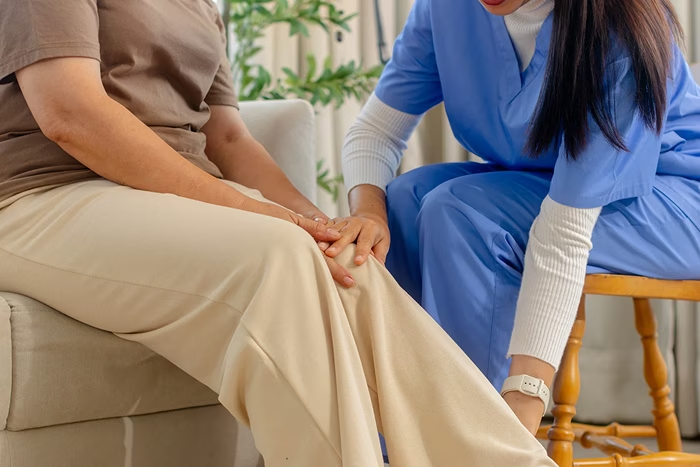

Knee Pain
Knee Pain Treatment in Brooklyn - Drug-Free Solutions When You Are Told Surgery Is Your Only Option
You used to take the stairs two at a time. Now you grip the railing and lower yourself one step at a time, bracing for the grinding, catching, aching protest from a knee that used to work without a second thought. Getting up from a chair has become a production. Walking more than a few blocks feels like a gamble. And somewhere in the back of your mind, a voice keeps repeating what a doctor told you: “You are going to need a knee replacement eventually.”
That voice is wrong – or at the very least, premature.
After twenty years of treating knee pain at our Brooklyn clinic – and over 15,000 patients treated across every joint condition imaginable -I can tell you this with clinical certainty: the vast majority of knee pain responds to advanced, non-surgical treatment when the right approach is applied before irreversible damage sets in. The catch is that most patients are never offered that approach. They receive a cortisone injection, a prescription for physical therapy that focuses on quad strengthening alone, and a timeline for when their knee will “need to be replaced.” That is not a treatment plan. That is a countdown.
You deserve better than a countdown. You deserve knee pain treatment that actually addresses what is happening inside your joint, around your joint, and throughout the mechanical chain that loads your knee with every step you take.
The Real Reasons Your Knee Pain Has Not Responded to Treatment
Knee pain is the most searched joint pain condition in the northeastern United States and one of the most poorly managed. Here is why.
The knee is not a simple hinge. It is a complex, multi-compartment joint that absorbs and transfers enormous forces during every movement up to four times your body weight when walking downstairs, and up to eight times during running. It depends on the integrity of cartilage surfaces, menisci, cruciate and collateral ligaments, the joint capsule, synovial fluid, and a network of muscles and tendons that must fire in precise coordination to keep the joint tracking properly.
When one element in that system breaks down, whether through osteoarthritis, a meniscus tear, bursitis, tendinopathy, or ligament strain, the rest of the system compensates. Muscles tighten asymmetrically. The patella begins to track improperly. Loading shifts to compartments that were never designed to bear it. And the original problem accelerates.
This is exactly why single-modality treatments fail. A cortisone injection temporarily reduces inflammation but does nothing to address the cartilage degeneration, muscular imbalance, or biomechanical dysfunction that caused it. Generic physical therapy strengthens the quadriceps while ignoring the VMO timing deficit, the hip weakness, and the ankle restriction that are driving abnormal knee mechanics. And the anti-inflammatory you take every morning is suppressing pain signals while the joint continues to deteriorate underneath.

I recently treated a patient, a 61-year-old retired postal worker from Canarsie who had been told by two orthopedic surgeons that he needed a total knee replacement. His X-rays showed moderate osteoarthritis. He had received five cortisone injections over two years, each providing less relief than the last. He had completed two rounds of physical therapy focused exclusively on straight-leg raises and terminal knee extensions.
When we evaluated him, we found what no one had looked for: severe ITB tightness and lateral retinacular restriction pulling his patella off track, significant weakness in the gluteus medius creating a valgus loading pattern with every step, trigger points in the vastus lateralis and popliteus referring pain deep into the joint, restricted ankle dorsiflexion forcing compensatory knee hyperextension, and an antalgic gait pattern that had been overloading his medial compartment for years. His cartilage was worn, yes. But the mechanical environment destroying it had never been addressed.
Twelve weeks of multimodal, drug-free knee pain treatment later, he was walking three miles daily, climbing stairs without pain, and his orthopedic surgeon acknowledged that surgery was no longer indicated. Not because the arthritis disappeared, it did not. But because the forces driving it were finally corrected.
→ Has your knee pain been managed instead of treated? Call our Brooklyn clinic or book your evaluation today.
Shockwave Therapy for Knee Pain - The Evidence Your Surgeon Has Not Mentioned
Extracorporeal Shockwave Therapy (ESWT) has emerged as one of the most clinically validated non-surgical technologies for knee pain, and the research continues to accelerate.
A 2024 umbrella review published in the International Journal of Surgery, which analyzed multiple systematic reviews and meta-analyses, confirmed that ESWT is effective in improving both pain and function in patients with knee osteoarthritis compared with non-ESWT treatments. A separate systematic review of twenty-four randomized controlled trials published in the Journal of Orthopaedics concluded that ESWT produced superior outcomes compared to several other conservative therapies and should be considered as a first-line treatment before more invasive options. A 2025 randomized controlled trial comparing ESWT, low-level laser therapy, and pulsed electromagnetic field therapy found that all three active treatments produced significant improvements over control, with ESWT requiring only three weekly sessions to achieve comparable results.
How does Shockwave Therapy work inside your knee? ESWT delivers focused acoustic energy directly into the affected joint structures. These pressure waves stimulate neovascularization, the formation of new blood vessels in under-perfused cartilage and subchondral bone. They trigger the release of growth factors that promote tissue repair. They reduce the concentration of substance P, a key pain mediator, in the treated area. And they break down fibrotic adhesions in the periarticular soft tissues that restrict movement and perpetuate compensatory loading patterns.
For patients with knee osteoarthritis, specifically, ESWT has been shown to stimulate repair in articular cartilage and subchondral bone, addressing the degenerative process itself rather than just the symptoms it produces. Published research demonstrated changes in both cartilage structure and subchondral bone remodeling following shock wave application, biological effects that no injection or oral medication can replicate.
Each session takes fifteen to twenty minutes. No anesthesia. No incision. No recovery period. You walk out and return to your day. Compare that to a total knee replacement, a major surgery requiring months of rehabilitation, carrying risks of infection, blood clots, nerve damage, and implant loosening, with a finite lifespan that may require revision surgery down the road.
When a non-surgical option offers documented effectiveness with zero downtime, it deserves serious consideration before anyone schedules you for surgery.
→ Find out if Shockwave Therapy can help your knee. Schedule your consultation now.
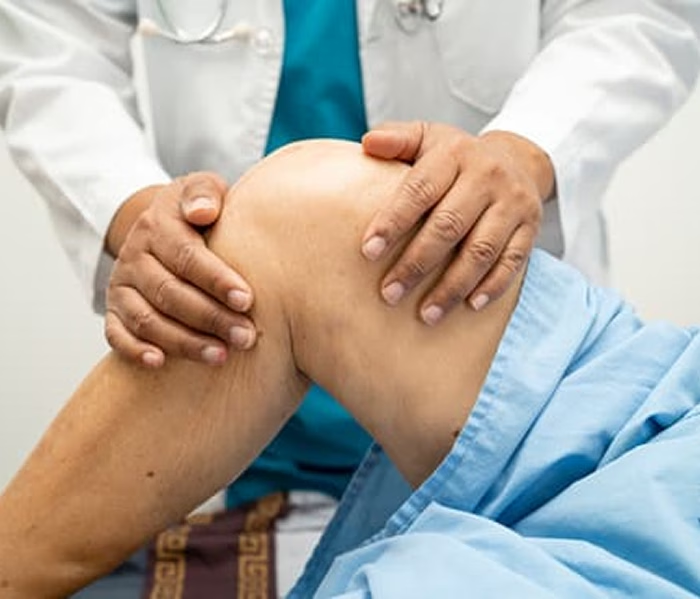
Laser Therapy and More: Restoring What Knee Injections Cannot
Shockwave Therapy anchors our knee protocol. But when we combine it with the full depth of our technology platform, recovery accelerates and outcomes strengthen in ways no single modality can achieve on its own.
High-Intensity Laser Therapy delivers concentrated photon energy deep into the knee joint, penetrating through the patella, joint capsule, and periarticular soft tissues to reach the cartilage surfaces, menisci, and inflamed synovium. At the cellular level, this energy increases blood flow within the joint, promotes nutrient exchange in cartilage tissue, stimulates tissue regeneration, and reduces pain, edema, and inflammation of suppressing pro-inflammatory cytokines, including interleukin-1, interleukin-6, and tumor necrosis factor-alpha. The photothermal effect also increases local tissue temperature in a controlled manner, enhancing synovial fluid viscosity and improving the lubrication dynamics within the joint.
Low-Level Laser Therapy (Photobiomodulation) targets the superficial muscular and tendinous structures around the knee, the patellar tendon, quadriceps complex, hamstrings, ITB, and popliteal region. A 2024 systematic review and network meta-analysis confirmed that LLLT at specific wavelengths produced significant reductions in knee osteoarthritis pain compared to sham treatment. For patients with patellar tendinopathy, bursitis, or ITB syndrome contributing to their knee pain, LLLT reduces inflammation and accelerates repair in these supporting structures. At the same time, deeper interventions address the joint itself.
Prolotherapy strengthens the ligamentous and capsular structures around the knee. For patients with chronic ligament laxity, whether from an old ACL sprain, medial collateral ligament insufficiency, or generalized joint hypermobility, prolotherapy uses a dextrose-based solution to provoke a controlled healing response that tightens and reinforces these critical stabilizers. A stable knee is a protected knee.
→ Every knee is different. Book your assessment and find out which treatment combination will work for you.
Your Complete Knee Recovery Plan From Hip to Ankle
Healing damaged tissue inside your knee is essential. But if the biomechanical forces that are overloading the joint remain uncorrected, degeneration continues regardless of how much technology you apply. That is why every knee pain treatment plan we design addresses the full kinetic chain from your hip through your knee to your ankle and foot.
Here is what a comprehensive knee recovery plan looks like at our Brooklyn practice:
- Detailed knee and biomechanical assessment We evaluate your knee joint integrity, patellar tracking, meniscal function, ligament stability, and range of motion. We assess your hip strength, ankle mobility, foot mechanics, and gait pattern. We use diagnostic therapeutic ultrasound to visualize joint structures in real time, identifying effusion, cartilage changes, soft tissue inflammation, and tendon pathology, and establish measurable baselines that we track throughout your care. No guesswork. Objective data from day one.
- Myofascial release and trigger point therapy. Chronic knee pain always generates compensatory tension patterns in the surrounding musculature. The ITB, vastus lateralis, popliteus, hamstrings, and gastrocnemius develop trigger points and adhesions that restrict patellar tracking, alter tibiofemoral mechanics, and refer pain deep into the joint. These soft tissue restrictions are invisible on imaging and invisible to providers who do not examine for them. We release them methodically, restoring the muscular balance your knee depends on.
- Neuromuscular re-education. Your quadriceps are not a single muscle; they are four muscles that must fire in precise timing to control patellar tracking and absorb load during movement. In chronic knee pain, the vastus medialis oblique (VMO), the primary medial stabilizer of the patella, almost always loses its activation timing relative to the vastus lateralis. This imbalance is one of the most common drivers of anterior knee pain, patellar maltracking, and accelerated cartilage wear. We specifically retrain this firing pattern, restoring the neuromuscular control that protects your joint.
- Progressive therapeutic exercise Knee rehabilitation follows a structured, evidence-based progression: pain-free range of motion, isometric strengthening, closed-chain functional loading, and dynamic stabilization. Every exercise is selected based on your specific diagnosis because the rehabilitation protocol for knee osteoarthritis is fundamentally different from the protocol for a meniscus tear, patellar tendinopathy, or ligament insufficiency. One-size-fits-all "knee strengthening" programs are one of the primary reasons patients fail to improve.
- Hip strengthening and postural correction. Weakness in the gluteus medius and gluteus maximus allows the femur to internally rotate and adduct during weight-bearing, driving the knee into a valgus position that overloads the medial compartment and stretches the lateral structures. This pattern is one of the most common biomechanical drivers of knee osteoarthritis. Yet, it is addressed in fewer than half of the knee rehabilitation programs I review from other providers. We correct it on the first visit.
→ This is what real knee pain treatment looks like. Call PainTherapyCare to build your recovery plan.
Who Needs Knee Surgery - And Who Does Not?
This is the question that matters most, and it deserves an honest answer.
Knee replacement surgery is a legitimate, life-changing intervention for patients with end-stage osteoarthritis with bone-on-bone degeneration and severe functional limitation that has genuinely failed comprehensive non-surgical care. Arthroscopic surgery has a role in certain acute meniscus tears, loose body removal, and specific ACL reconstruction cases in younger, active patients.
But here is what the data tells us: a significant percentage of knee surgeries performed in the United States are performed on patients who have not exhausted, or in many cases have not even been offered, the advanced non-surgical options that could have resolved their condition. Patients are told they need surgery based on an X-ray showing moderate arthritis arthritis that is present in the imaging of millions of people who have no knee pain whatsoever. The correlation between imaging findings and pain is far weaker than most patients realize, and far weaker than the surgical referral rate suggests.
In my practice, I treat patients every week who were told surgery was their only option and who recover fully without it. That is not because surgery is never appropriate. It is because the threshold for recommending it has fallen below what the evidence supports, particularly for patients who have never received multimodal, technology-driven conservative care.
You owe it to yourself to try every evidence-based non-surgical option before committing to an irreversible procedure.
Take the Next Step – Your Knee Can Still Carry You
I have treated Brooklyn bus drivers who could not press a brake pedal without grimacing and watched them return to full duty. I have treated weekend basketball players from Crown Heights who were told to give up the sport they love and helped them get back on the court. I have treated grandmothers from Sheepshead Bay who could not kneel to play with their grandchildren and saw them on the floor with those kids eight weeks later.
Those results do not come from a single injection or a generic exercise sheet. They come from a comprehensive, multimodal approach that treats the joint, the muscles, the biomechanics, and the forces driving degeneration simultaneously and precisely.
If you are searching for knee pain treatment without surgery in Brooklyn, Queens, the Bronx, or anywhere across New York City, and if you need a knee pain specialist who will look beyond your X-ray and treat the complete picture our practice was designed for this.
Related reading: how to avoid knee replacement surgery and managing knee pain after jumping or impact activity.
Your knees have carried you through every step of your life. They deserve treatment built for what comes next.
→ Call PainTherapyCare today or book your consultation online. Let us show you what your knee can still do.