

Carpal Tunnel Syndrome
Carpal Tunnel Treatment in Brooklyn - Proven Drug-Free Relief That Saves Your Hands and Avoids Surgery
It started with tingling in your fingers at night. You shook your hand, the sensation faded, and you forgot about it. Then the numbness started creeping in during the day. While typing. While driving. While holding your phone. Now your thumb feels weak. You are dropping things. Buttoning a shirt takes concentration. Gripping a jar requires both hands. And the burning in your wrist and palm has become a constant companion that follows you from morning until the moment you fall asleep, only to wake you at 3 am with that same tingling that will not stop.
If this sounds like your life, you almost certainly have carpal tunnel syndrome. And if someone has told you that surgery is the only real solution, I need you to know that is not accurate.
Carpal tunnel syndrome is the most common nerve entrapment condition in the world, affecting roughly 3.8% of the general population. It is more common in women, increases with age, and has risen steadily with the growth of computer-based work and smartphone use. But despite its prevalence, carpal tunnel treatment without surgery remains dramatically underutilized. Most patients are offered a wrist splint, told to rest, and then referred for carpal tunnel release surgery when the splint does not resolve their symptoms. That pathway skips an entire category of advanced, non-surgical interventions that published research shows can improve pain, restore hand function, and reduce median-nerve compression without a single incision.
After twenty years and over 15,000 patients treated at our Brooklyn practice, I have helped hundreds of carpal tunnel patients recover full hand function through drug-free, non-surgical treatment. Not by waiting and hoping. By targeting the nerve compression at its source with technology that reaches the median nerve where it is trapped and creates the conditions for genuine recovery.
Why Splints Fail, and Surgery Is Not Your Only Alternative
The standard pathway for carpal tunnel treatment is: wear a wrist splint at night for six weeks. If symptoms persist, receive a cortisone injection into the carpal tunnel. If that provides temporary relief that fades, schedule a carpal tunnel release surgery. Published data show that up to 19% of patients experience recurrent symptoms after surgery, and up to 12% require a second operation.
So why does this pathway fail so many patients?
Because it treats the carpal tunnel as an isolated, mechanical problem. A tight space. A compressed nerve. Cut the ligament, make more room, problem solved. But in my clinical experience, the carpal tunnel is rarely the only site of compression, and mechanical overload on the median nerve rarely originates solely from the wrist.
The median nerve travels from your cervical spine, through the thoracic outlet between your scalene muscles and first rib, down the arm between the pronator teres muscles in your forearm, and into the carpal tunnel at the wrist. At every one of these points, the nerve can be compressed, irritated, or restricted. When compression exists at multiple sites simultaneously, a concept called “double crush syndrome,” the nerve becomes far more vulnerable to injury at each location. Releasing the carpal tunnel surgically while leaving the upstream compression sites untreated is one of the primary reasons that post-surgical symptoms persist or recur.

I recently treated a patient, a 48-year-old legal secretary from Carroll Gardens, who had been living with bilateral carpal tunnel symptoms for over eighteen months. She wore wrist splints nightly. She received a cortisone injection in her right wrist that helped for about five weeks before the symptoms returned at full intensity. Her hand surgeon recommended bilateral carpal tunnel release.
When we evaluated her, we found what no one had looked for: chronic forward head posture and tight scalenes, creating mild bilateral thoracic outlet compression of the brachial plexus. Active trigger points in both pronator teres muscles are producing forearm pain and contributing to median nerve irritation proximal to the carpal tunnel. Chronic wrist flexor hypertonicity from 8 hours of daily typing increases pressure within the carpal tunnel. And a significant weakness in her scapular stabilizers, allowing her shoulders to protract and roll forward, compressing the neurovascular bundle at the thoracic outlet with every hour she spent at her desk.
Her median nerve was being compressed at three distinct locations, not one. The carpal tunnel was the most symptomatic point, but it was not the only one. And releasing the transverse carpal ligament surgically would have addressed one-third of the problem while leaving the other two-thirds completely untouched.
We treated all three levels simultaneously. Within ten weeks, her nighttime symptoms had resolved, her grip strength had returned to normal, and she was working full days at her keyboard without numbness, tingling, or pain. No surgery. No ongoing splinting. No medications.
→ Has your carpal tunnel been evaluated at one site when the problem may involve three? Call our Brooklyn clinic or book your evaluation today.
Laser Therapy for Carpal Tunnel - The Evidence That Should Change Standard Practice
If there is one technology that deserves far more attention in carpal tunnel treatment, it is laser therapy. The published evidence is extensive and growing.
A 2025 systematic review and meta-analysis published in Lasers in Medical Science analyzed photobiomodulation for carpal tunnel syndrome and found significant improvements in hand functionality across the included studies. A separate 2025 comprehensive meta-analysis of 13 randomized trials confirmed that LLLT significantly improves hand function in patients with CTS. A network meta-analysis published in the journal Physiotherapy found that LLLT plus splinting had the highest probability of pain reduction of any conservative treatment combination studied for carpal tunnel syndrome, at 75%.
A 2025 network meta-analysis published in the Archives of Physical Medicine and Rehabilitation compared the efficacy of all major conservative treatments for CTS, including manual therapy, steroid injections, Shockwave Therapy, and laser therapy. The study confirmed that advanced conservative approaches produce meaningful outcomes and called for multimodal strategies rather than single-modality treatment.
A 2024 randomized clinical trial published in the Journal of Hand Therapy directly compared extracorporeal Shockwave Therapy and low-level laser therapy added to conventional physical therapy for mild-to-moderate carpal tunnel syndrome. Both ESWT and LLLT produced measurable reductions in median nerve cross-sectional area and significant pain improvement.
How does laser therapy work for carpal tunnel syndrome?
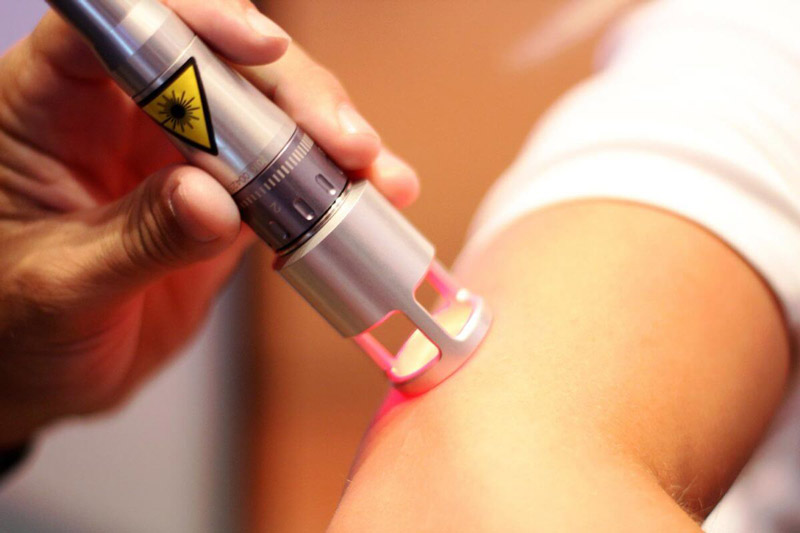
Low-Level Laser Therapy (Photobiomodulation) delivers specific light wavelengths directly over the carpal tunnel, where the photons penetrate through the transverse carpal ligament and are absorbed by the compressed median nerve. At the cellular level, this energy accelerates mitochondrial ATP production in nerve cells, reduces inflammatory mediators in the carpal tunnel, modulates pain signaling, and stimulates biological repair processes that allow the nerve to recover from chronic compression. The ideal treatment parameters identified in the research are wavelengths between 780 and 860 nanometers, delivered over 10 to 15 treatment sessions.
High-Intensity Laser Therapy provides deeper penetration and a stronger photon density, allowing us to target not only the carpal tunnel itself but also the pronator teres region, the forearm flexor compartment, and the deeper structures along the median nerve’s pathway. For patients with double-crush presentations in which compression occurs at multiple levels, HILT addresses upstream sites that LLLT applied to the wrist alone cannot reach.
→ Thirteen randomized trials confirm what our patients experience. Schedule your laser therapy consultation now.
Shockwave Therapy, Myofascial Release, and Treatment Options
Carpal tunnel syndrome is never just a nerve problem. The muscles, tendons, fascia, and connective tissues of the forearm, wrist, and hand all contribute to the compression, and all must be treated for lasting results.
Extracorporeal Shockwave Therapy (ESWT) targets the soft tissue environment surrounding the median nerve. Focused acoustic waves break down fibrotic adhesions in the transverse carpal ligament and flexor retinaculum, reduce chronic inflammatory thickening of the synovial membranes around the flexor tendons within the carpal tunnel, and stimulate neovascularization in under-perfused tissues. The 2024 randomized trial in the Journal of Hand Therapy confirmed that ESWT produces measurable reductions in median nerve cross-sectional area, providing objective evidence that the nerve compression itself is being reduced, not just the symptoms it produces.
Myofascial release and trigger point therapy address the muscular drivers of carpal tunnel compression that no wrist splint or injection can resolve. The pronator teres, flexor digitorum superficialis, flexor carpi radialis, and flexor carpi ulnaris all develop chronic hypertonicity and trigger points in patients with carpal tunnel syndrome. These muscles increase pressure inside the carpal tunnel from above and create secondary entrapment of the median nerve in the proximal forearm. We release them systematically, reducing compressive forces on the nerve along its entire pathway from the elbow to the fingertips.
Neuromuscular re-education retrains the activation patterns of the hand, wrist, and forearm muscles. Chronic carpal tunnel syndrome disrupts the timing and coordination of the intrinsic hand muscles, the thenar eminence (the muscles at the base of your thumb), and the forearm extensors. This disruption produces the weakness, clumsiness, and loss of fine motor control that patients describe. We rebuild these patterns through targeted exercises that restore the neuromuscular coordination your hands depend on.
Therapeutic ultrasound serves a critical diagnostic role in our carpal tunnel protocol. We visualize the median nerve in real time, measuring its cross-sectional area at the carpal tunnel and comparing it to normative values. This provides objective confirmation of the diagnosis and a measurable baseline we track throughout treatment. We can see whether the nerve is improving structurally rather than just symptomatically.
→ Every layer of compression must be treated for lasting results. Book your comprehensive carpal tunnel assessment today.
Your Complete Carpal Tunnel Recovery Plan
Decompressing the median nerve is the priority. Keeping it decompressed requires addressing the ergonomic, postural, and muscular factors that created the compression.
Here is what your plan includes:
- Comprehensive nerve and biomechanical assessment. We evaluate your median nerve function through clinical testing, measure nerve cross-sectional area with diagnostic ultrasound, assess for compression at the carpal tunnel, pronator teres, and thoracic outlet, examine your cervical spine for contributing radiculopathy, evaluate your forearm and wrist muscle tone, and analyze your workstation ergonomics and daily hand-use patterns. You leave your first visit knowing exactly where your nerve is compressed, how severely, and what we will do about it.
- Structured laser and shock wave protocol. Based on your specific compression pattern, we deploy the combination of LLLT, HILT, and ESWT that matches your diagnosis. A straightforward carpal tunnel compression receives a different protocol than a double crush presentation involving the thoracic outlet and pronator teres. Your treatment is matched to your anatomy, not to a generic template.
- Progressive hand and wrist rehabilitation. We rebuild grip strength, pinch strength, fine motor control, and thenar muscle activation through a structured exercise progression. Tendon gliding exercises and nerve mobilization techniques are incorporated from the first week to improve median nerve excursion within the carpal tunnel and reduce adhesions that restrict its movement.
- Postural correction and ergonomic modification. Forward head posture, rounded shoulders, and chronic wrist flexion during computer use are the three most common biomechanical contributors to carpal tunnel syndrome in the patients I treat. We address all three with specific corrections tailored to your work environment and daily habits. For many patients, postural correction alone produces a measurable reduction in symptoms by reducing upstream compression that makes the carpal tunnel the breaking point.
- Custom splinting when appropriate. Neutral wrist splints worn at night reduce intratunnel pressure during sleep and complement active treatment. But splinting alone is a passive strategy. Within our comprehensive protocol, it plays a supporting role, not a primary one.
→ This is what real carpal tunnel treatment looks like. Call PainTherapyCare to build your recovery plan.
When Does Carpal Tunnel Syndrome Require Surgery?
Carpal tunnel release surgery is a well-established procedure for patients with severe median nerve compression that has produced significant thenar muscle atrophy, constant numbness, or measurable loss of nerve conduction that has not responded to comprehensive conservative care.
But the threshold for recommending surgery has dropped far below what the evidence supports. Many patients are referred for surgery after failing a course of wrist splinting alone, without ever being offered the advanced conservative interventions that published research shows can produce meaningful improvement. That is not a failure of conservative treatment. That is a failure to deliver it.
Published data confirm that carpal tunnel syndrome progresses slowly in most patients, and some cases recover spontaneously. Conservative treatment is appropriate and effective for mild and moderate presentations, which represent the majority of diagnoses. When comprehensive non-surgical care is delivered, including laser therapy, Shockwave Therapy, myofascial release, neuromuscular re-education, and postural correction, the percentage of patients who genuinely need surgery drops significantly.
You owe it to your hands to try every evidence-based non-surgical option before consenting to a procedure that cuts the primary structural support of your wrist.
Your Hands Build Your Life. They Deserve Treatment That Protects Them.
I have treated data entry specialists from Downtown Brooklyn who could not type a sentence without numbness spreading through their fingers and watched them return to full productivity within eight weeks. I have treated chefs from Greenpoint whose knife work had become dangerous because they could not feel the handle in their grip, and helped them regain the sensation and control their craft demands. I have treated musicians from Fort Hamilton who had been told their playing days were over, only to see them performing again three months later.
Those recoveries did not come from a wrist splint worn at night. They came from identifying every site of median nerve compression, treating every tissue contributing to it, correcting the postural and ergonomic factors perpetuating it, and rebuilding the neuromuscular function that chronic compression had stolen.
If you are searching for carpal tunnel treatment without surgery in Brooklyn, Queens, the Bronx, or anywhere across New York City, and if you need a carpal tunnel specialist who understands that your wrist is only one part of a much larger compression picture, our practice was built for exactly this.
Your hands are the most complex and capable tools you possess. They deserve treatment that matches their complexity.
→ Call PainTherapyCare today or book your consultation online. Let us show you what your hands can do when the pressure on that nerve is finally released.