

Sciatica
Sciatica Treatment in Brooklyn - Non-Surgical Relief That Targets the Real Source of Your Pain
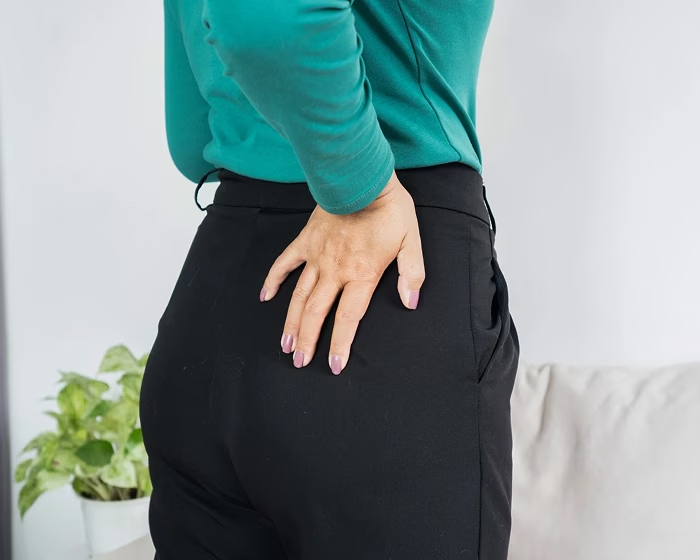
The pain started in your lower back. Now it shoots down your leg like an electrical current burning through your buttock, searing behind your thigh, sometimes reaching all the way to your foot. Sitting makes it worse. Standing makes it worse. You cannot find a single position that gives you more than a few minutes of relief, and the sleepless nights are starting to break you down.
If that is where you are right now, I want to be direct with you: you do not have to live like this, and you almost certainly do not need surgery to stop it.
Sciatica is the most searched musculoskeletal condition in the United States for a reason: it affects up to 40% of the population at some point in their lives, and when it strikes, it dominates everything. But after twenty years and over 15,000 patients treated at our Brooklyn practice, I can tell you that the vast majority of sciatica cases I see, including severe, chronic, debilitating cases, respond to advanced non-surgical sciatica treatment when the right protocols are applied by someone who understands what is actually compressing that nerve.
The problem is not that effective treatment does not exist. The problem is that most patients never receive it.
What Is Actually Causing Your Sciatica - And Why Most Treatments Miss It
Here is the question I ask every new sciatica patient who walks into our Brooklyn clinic: Who actually diagnosed the cause of your sciatic nerve compression?
Not the symptom. The cause. Because sciatica is not a diagnosis, it is a description of where your pain travels. The real question is what is irritating or compressing your sciatic nerve, and until that question is answered with precision, every treatment you receive is a guess.
Approximately 90% of sciatica cases originate from a lumbar disc herniation, a bulging or ruptured disc pressing directly against a nerve root in your lower spine. But that still leaves a significant number of patients whose sciatica comes from something else entirely: spinal stenosis, narrowing of the neural canal, piriformis syndrome, where a deep hip muscle clamps down on the nerve, spondylolisthesis, shifting one vertebra over another, or degenerative changes that gradually reduce the space available for the nerve to function.
Each of these causes demands a different treatment strategy. And that is precisely where most sciatica treatment plans fail.

I recently treated a patient a 47-year-old Brooklyn electrician, who had been told his sciatica was caused by a disc herniation at L4-L5. An MRI confirmed the bulge. He was prescribed oral steroids, referred for six weeks of generic physical therapy, and offered an epidural injection when the PT did not work. None of it made a meaningful difference, and the next recommendation was a microdiscectomy.
When we evaluated him at our clinic, we found something his previous providers had overlooked: severe piriformis hypertonicity on the affected side, significant trigger points in the gluteus minimus and deep external rotators, restricted sacroiliac joint mobility, and a lumbar segmental instability pattern at L4-L5 that no amount of passive treatment was going to resolve. Yes, the disc was bulging. But the muscular and biomechanical environment around his spine was the reason that disc was under constant, unrelenting pressure. Treat only the disc, and the forces that caused the herniation remain active, loading and re-loading the same segment day after day.
We addressed the entire system. Within ten weeks, his leg pain had resolved completely, his disc was decompressing naturally, and he returned to full duty. No surgery. No injections. No drugs.
That outcome is not unusual when sciatica treatment is built on a complete diagnosis, not a partial one.
→ Still chasing a solution for your sciatic nerve pain? Call our Brooklyn clinic or book your evaluation online today.
Laser Therapy for Sciatica: Reaching the Nerve Where It Hurts Most
One of the most significant challenges in treating sciatica is reaching the structures that are actually causing the problem. The sciatic nerve is the longest and thickest nerve in the human body, and the compression sites, whether at the lumbar spine, the sacral foramina, or deep within the piriformis, are buried beneath layers of muscle and connective tissue that superficial treatments simply cannot penetrate.
This is why High-Intensity Laser Therapy has become a centerpiece of our sciatica treatment protocol at our Brooklyn practice.
How it works: High-Intensity Laser delivers concentrated photon energy that penetrates up to four inches beneath the skin, deep enough to reach the lumbar nerve roots, the inflamed disc-nerve interface, and the piriformis-sciatic junction. At the cellular level, this energy accelerates mitochondrial ATP production, which powers tissue repair and regeneration. Simultaneously, it reduces pro-inflammatory cytokines,s including interleukin-1, interleukin-6, and tumor necrosis factor-alpha at the site of compression. It triggers the release of endorphins and serotonin at peripheral nerve endings. And it enhances local blood circulation, delivering oxygen and nutrients to tissues that are often starved of oxygen and nutrients due to chronic compression.
Published research has demonstrated that laser photobiomodulation selectively modulates small-diameter sensory nerve fibers, the fibers responsible for transmitting pain, without disrupting motor function. That means we can directly reduce sciatic pain signaling while preserving your strength, coordination, and movement. A 2024 study in the Journal of Pain Research confirmed that direct photobiomodulation on the sciatic nerve significantly attenuates pain sensitivity without affecting motor output.
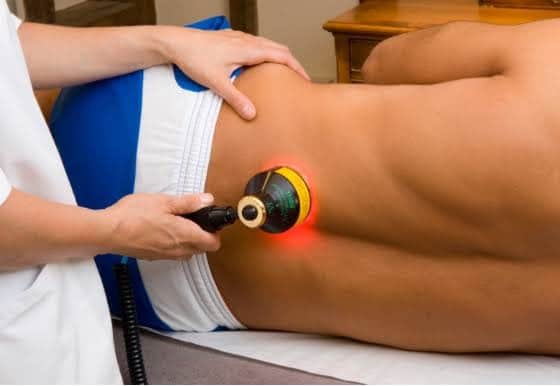
Low-Level Laser Therapy (LLLT) complements our high-intensity protocol by targeting the superficial muscular and fascial tissues that contribute to nerve irritation. For patients with significant muscular guarding, paraspinal inflammation, or piriformis involvement, LLLT accelerates recovery in these supporting structures, while the high-intensity laser targets deeper nerve and disc pathology.
The combination is powerful. Most patients report measurable pain reduction within the first three to four sessions, not temporary masking, but genuine neurological and inflammatory change at the compression site.
→ Find out how laser therapy can relieve your sciatic nerve pain. Schedule your consultation now.
Shockwave Therapy and Spinal Decompression - Breaking the Cycle of Chronic Compression
For patients with chronic sciatica, particularly those whose condition has persisted for three months or longer, two additional technologies anchor our treatment approach.
Extracorporeal Shockwave Therapy (ESWT) delivers focused acoustic pressure waves into the tissues surrounding the sciatic nerve. In cases of piriformis syndrome, ESWT has been shown to reduce piriformis muscle hardness and decrease the cross-sectional area of the compressed sciatic nerve, resulting in documented improvements that correlate directly with pain reduction and functional recovery. For lumbar-origin sciatica, Shockwave Therapy targets the paraspinal musculature, breaks down fibrotic adhesions, stimulates neovascularization in under-perfused tissues, and triggers growth factor release that promotes tissue remodeling.
Research published in PMC has demonstrated that low-intensity extracorporeal Shockwave Therapy promotes sciatic nerve recovery by activating Schwann cells, which maintain the myelin sheath that insulates and protects nerve fibers. When the myelin sheath is compromised by chronic compression, nerve signaling degrades, producing the numbness, tingling, and weakness that define severe sciatica. ESWT stimulates the biological machinery that repairs this damage from the inside out.
Non-surgical spinal decompression addresses the mechanical root of disc-related sciatica directly. By applying calibrated, intermittent traction forces to the lumbar spine, decompression therapy creates negative intradiscal pressure. This vacuum effect encourages retraction of herniated disc material away from the compressed nerve root. Simultaneously, it enhances the diffusion of water, oxygen, and nutrients into the disc, supporting the disc’s ability to heal rather than simply being managed.
Published findings confirm that patients undergoing non-surgical spinal decompression experience significant reductions in pain, increased mobility, and improved quality of life outcomes that hold up over time when combined with active rehabilitation and biomechanical correction.
These are not alternative therapies on the fringe of medicine. They are advanced, evidence-based interventions used in sports medicine and rehabilitation worldwide. What we have done at our Brooklyn practice is integrate them into a coordinated protocol specifically designed for sciatic nerve compression.
→ Chronic sciatica demands more than temporary relief. Book your assessment and let us build a real recovery plan.
Your Complete Sciatica Recovery Plan - From Spine to Sciatic Nerve
Eliminating sciatic nerve pain requires more than reducing inflammation at the compression site. If the spinal instability, muscular dysfunction, and postural patterns that created the compression remain uncorrected, the pain often returns, often worse than before. That is why every non-surgical sciatica treatment plan we design addresses the full kinetic chain from your lumbar spine to the path of the sciatic nerve.
Here is what comprehensive sciatica recovery looks like at our Brooklyn practice:
- Precise diagnostic evaluation. We assess your lumbar spine segmental mobility, disc integrity, sacroiliac joint function, piriformis length and tone, hip rotator flexibility, and neural tension through the full length of the sciatic nerve. We use diagnostic therapeutic ultrasound to visualize soft tissue structures, identify areas of inflammation or compression, and establish objective baselines we track throughout your care. We do not guess. We measure. Myofascial release and trigger point therapy. Chronic sciatica always produces compensatory muscular tension. The piriformis, gluteus minimus, quadratus lumborum, deep lumbar multifidus, and paraspinal muscles develop trigger points and adhesions that both perpetuate nerve compression and generate referred pain patterns that overlap with and amplify the primary sciatic pain. We release these tissues methodically, restoring the space and mobility the nerve needs to function without irritation.
- Neuromuscular re-education. After months or years of sciatica, your core stabilization system has broken down. The deep lumbar stabilizers, transversus abdominis, multifidus, and pelvic floor stop activating properly. Your body compensates with global muscles that generate force but cannot stabilize individual spinal segments. This instability keeps the disc under compression and the nerve under threat. We retrain these activation patterns from the ground up, rebuilding the segmental stability that protects your spine and your nerves.
- Progressive therapeutic exercise Controlled loading of the lumbar spine and lower extremity follows a specific, evidence-based progression: pain-free range of motion, isometric stabilization, dynamic strengthening, and functional integration. Research consistently shows that structured exercise programs produce long-term outcomes for sciatica that are comparable to or better than surgery, but only when the program is designed by a clinician who understands spinal biomechanics and neural tension
- Postural correction, prolonged sitting, anterior pelvic tilt, and lumbar flexion bias increase intradiscal pressure and narrow the neural foramen, in the exact mechanical environment that produces and sustains sciatica. We assess and correct your postural patterns based on your daily demands, whether you sit at a desk for ten hours or work on your feet all day.
→ This is what a real sciatica treatment plan looks like. Call PainTherapyCare to start yours.
The Evidence Is Clear: Surgery Should Be a Last Resort, Not a First Recommendation
If someone has recommended surgery for your sciatica, you deserve to know what the research actually says.
A landmark systematic review and meta-analysis published in the BMJ in 2023, pooling data from twenty-four randomized controlled trials found that while discectomy provided moderate short-term pain relief compared to non-surgical treatment, the benefits declined steadily over time and became negligible at long-term follow-up. For disability outcomes, the differences between surgical and non-surgical groups were small to nonexistent.
A 2024 meta-analysis in Cureus went further, concluding that conservative treatment was associated with significant reductions in leg pain and significant improvements in both mental and physical health scores compared to surgical intervention for chronic sciatica lasting more than three months.
The SPORT trial one of the largest randomized studies ever conducted on spinal surgery, found no statistically significant differences between surgery and structured conservative care at long-term follow-up for lumbar disc herniation with sciatica.
Does this mean surgery is never appropriate? No. Surgical intervention has a role for patients with progressive neurological deficits, cauda equina syndrome, or severe radiculopathy that fails to respond to comprehensive non-surgical care over a reasonable timeframe. But the data are unambiguous: for the majority of patients with sciatica, a well-designed, multimodal non-surgical protocol produces equivalent or superior long-term outcomes without the risks, costs, and recovery time of surgery.
That is the approach we deliver at our Brooklyn practice. Not as a lesser alternative to surgery but as the evidence-based standard of care that published research supports.
Stop Waiting for Sciatica to Resolve on Its Own
Some sciatica does improve spontaneously. Published data suggest that roughly 50% of patients with acute sciatica report improvement within ten days, and about 75% improve within four weeks. But that means one in four patients does not improve, and many of those develop chronic sciatica that persists for months or years, progressively damaging the nerve and eroding quality of life with every passing week.
If your sciatica has lasted more than a few weeks, or if it involves numbness, tingling, or weakness in your leg, you have already moved beyond the window where watchful waiting is a reasonable strategy. The nerve is being compressed. The longer it remains compressed, the greater the risk of permanent neurological changes.
I have treated Brooklyn construction workers who could not climb a ladder. Office workers in Downtown Brooklyn who could not sit through a meeting. Parents in Park Slope who could not pick up their children. And I have watched every one of them return to full function after receiving the kind of comprehensive, non-surgical sciatica treatment that should have been their first option, not their last.
Sciatica is the most treatable condition we see, and the one most often overtreated with surgery.
If you are searching for non-surgical sciatica treatment in Brooklyn, Queens, the Bronx, or anywhere across New York City, and if you need a sciatica doctor who will identify exactly what is compressing your nerve and build a plan to fix it without drugs or surgery, our practice was built for you.
Your sciatic nerve controls everything from your lower back to your foot. Protect it with treatment that actually works.
→ Call PainTherapyCare today or book your consultation online. Relief is closer than you think.