
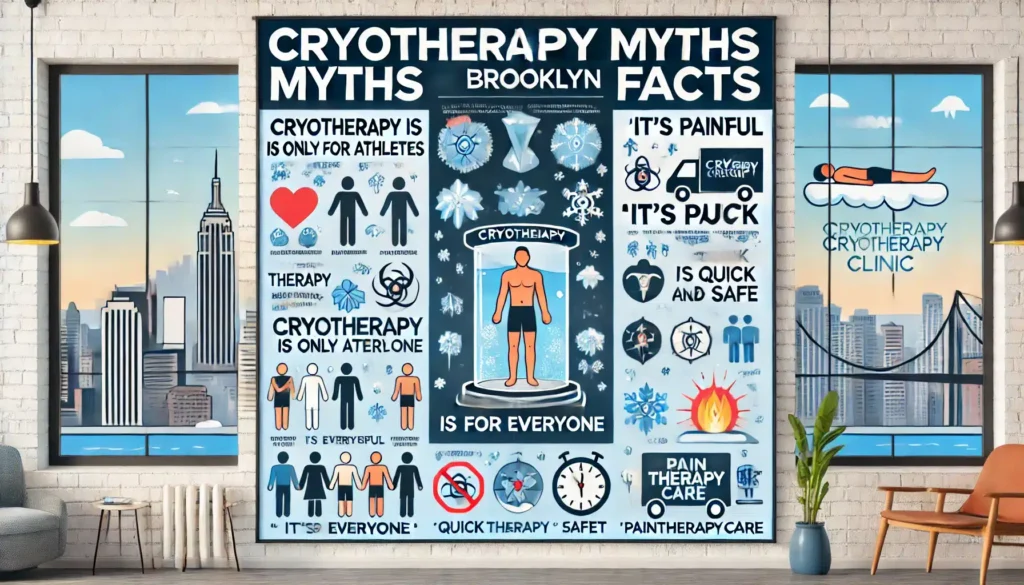
Cryotherapy has picked up a lot of claims online, some accurate, some not. Here is a straightforward look at what is myth and what is fact for Brooklyn residents considering it. The Brooklyn detail is in cryotherapy for pain in Brooklyn, New York.
Myth: Cryotherapy cures chronic pain
Fact: Cryotherapy is not a cure. It may help reduce inflammation and provide temporary relief for some patients, but it works best as one part of a broader treatment plan, not a stand-alone fix.
Myth: Cryotherapy is only for professional athletes
Fact: While athletes popularized cryotherapy for recovery, everyday patients managing arthritis, joint pain, or muscle soreness use it too. It is not exclusive to elite sports.
Myth: Colder is always better
Fact: Cryotherapy sessions are carefully timed and supervised precisely because more exposure is not automatically more effective, and can carry more risk. A controlled, brief session is the standard approach.
Myth: Results are the same for everyone
Fact: Response to cryotherapy varies by condition and by individual. Some patients notice a possible improvement quickly, others need several sessions before seeing any change, and some conditions respond better to other drug-free options like shockwave or laser therapy.
Myth: Insurance never covers it
Fact: Coverage depends on your plan and how the treatment fits into your overall care plan. It is worth asking your provider directly rather than assuming it is out of reach.
The best way to separate fact from marketing is a real conversation with a pain management provider who can explain whether cryotherapy fits your specific situation.
Frequently asked questions
Has whole-body cryotherapy been approved by the FDA?
No. The FDA has stated that it has not cleared or approved any whole-body cryotherapy device for treating medical conditions, and has published a consumer note about the claims made for it. That does not mean cold therapy has no value, but it does mean marketing claims about curing disease have not passed a regulatory review.
Is a session at a cryotherapy spa the same as one in a medical clinic?
The cold exposure may be similar, but the context is not. A clinical setting normally involves a health history review, a reason for treatment tied to a diagnosis, and a plan that includes other care. A walk-in wellness session generally does not. Anyone with a heart, circulatory or nerve condition benefits from that screening step regardless of where the chamber is.
Does cryotherapy burn calories or help with weight loss?
That claim is overstated. Brief cold exposure does raise energy use slightly while the body rewarms, but the amount is small and short-lived, and there is no good evidence that repeated sessions produce meaningful weight loss on their own. Calorie figures quoted in advertising are estimates rather than measurements. Cryotherapy is better judged on symptoms.
Is a chamber with the head outside different from a full-body one?
Yes. Most nitrogen-cooled units leave the head above the opening so the cold gas is not inhaled, while electric walk-in rooms enclose the whole body and typically run at a less extreme temperature for longer. Localized devices treat a single area only. The terms are used loosely in advertising, so it is worth asking which type a facility operates.
Wondering whether cryotherapy applies to your pain?
A physician-led evaluation matches the treatment to the diagnosis. More on cryotherapy.
Serving Brooklyn, the Five Towns, and Monsey.


