For patients weighing whether to move forward with surgery or steroid injections, shockwave therapy is worth understanding as a non-surgical option that’s often tried earlier in the treatment process.
Why Patients Look for Alternatives First
Surgery carries recovery time, risk, and cost, and repeated steroid injections come with their own limitations, including a cap on how often they can safely be used in the same area. For chronic tendon and soft tissue conditions that haven’t responded to rest and physical therapy alone, shockwave therapy is often tried as a non-surgical option before more invasive steps.
How It Works
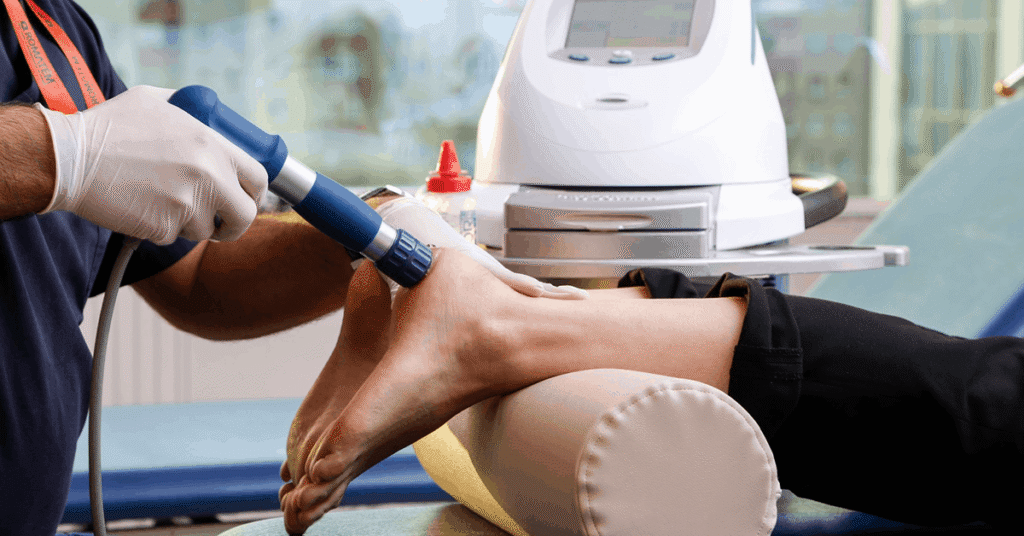
Shockwave therapy delivers acoustic pressure waves to the affected tissue, which may help stimulate blood flow and the body’s natural healing response in chronically irritated tendons and connective tissue. It’s most commonly used for conditions like plantar fasciitis, tendinitis, and other soft tissue injuries that have become chronic.
What the Research Suggests
Studies suggest shockwave therapy can lead to meaningful improvement for certain chronic tendon conditions, though results vary by condition and by patient. It’s generally viewed as a reasonable option to try before surgery, though it isn’t a guaranteed alternative and doesn’t work for every case.
What a Treatment Course Involves
Shockwave therapy typically requires a series of sessions rather than a single treatment, spaced about a week apart. Sessions are generally well tolerated, with some mild soreness during and shortly after treatment being the most common and short-lived side effect. Individual results vary, and shockwave therapy is not guaranteed to eliminate the need for surgery or injections.
If you’re weighing your options before surgery or another round of steroid injections, a pain management provider can help you understand whether shockwave therapy makes sense to try first.
Frequently asked questions
How long after a cortisone injection can shockwave therapy be started?
Many providers wait several weeks after a steroid injection before beginning shockwave, so the intended tissue response is not blunted and so it stays clear which treatment is responsible for any change. The interval varies with the site and with how many injections have been given. Reporting the date of the last injection matters more than any fixed waiting period.
Does trying shockwave first delay surgery if surgery turns out to be needed?
A course usually runs a few weeks, which is short relative to the wait for most elective procedures, and shockwave does not alter tissue in a way that complicates a later operation. Timing does matter for problems such as a complete tendon rupture or nerve compression with weakness, where delay can affect the surgical result, so those need assessment first.
Is shockwave therapy the same as the ultrasound used in physical therapy?
No. Therapeutic ultrasound delivers continuous sound energy mainly to warm tissue, while shockwave delivers short, high-pressure acoustic pulses intended to provoke a repair response in chronically irritated tissue. The sensation differs as well: shockwave is felt as sharp tapping and can be briefly uncomfortable, whereas therapeutic ultrasound is usually barely noticeable.
Can a course of shockwave therapy be repeated if the pain comes back?
Usually yes. Repeat courses are common for chronic tendon problems that flare again with a return to heavy activity, and there is no lifetime cap of the kind that applies to repeated steroid injections in one area. A provider would normally reexamine first, since returning pain can mean the load or technique driving the problem has not been addressed.
Wondering whether shockwave therapy is right for you?
An assessment says honestly whether it fits the condition. More on shockwave therapy.
Book an AssessmentServing Brooklyn, the Five Towns, and Monsey.


