

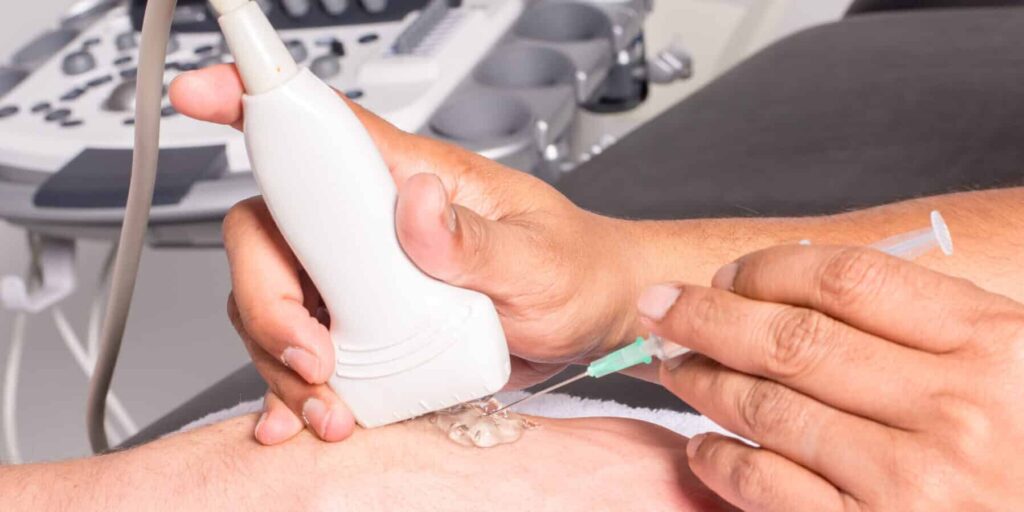
Ultrasound-guided injections are one of the more precise interventional tools available to Brooklyn pain patients. Here is a clear look at how the technique works.
What ultrasound guidance adds
Ultrasound imaging allows a physician to see soft tissue, joints, and nearby structures in real time while positioning a needle, improving accuracy compared to an injection done without imaging guidance.
Conditions this technique is used for
Ultrasound-guided injections are commonly used for joint pain, tendon injuries, and soft tissue conditions where precise placement of medication can meaningfully affect the outcome.
What the procedure involves
The procedure is done in a clinical setting using a handheld ultrasound probe alongside the injection. Most patients tolerate the procedure well and are able to resume normal activity soon after, with some soreness at the site being common.
How this compares to other guided techniques
Unlike fluoroscopy, ultrasound guidance does not use radiation, which makes it a preferred option for certain soft tissue targets and for patients where radiation exposure is a consideration. How image guidance is applied to pain procedures is set out in fluoroscopic guided injection for pain management.
Discussing whether it fits your condition
A pain management specialist can evaluate whether an ultrasound-guided injection, a drug-free option like shockwave or laser therapy, or a combination of approaches best fits your specific diagnosis.
Frequently asked questions
Does an ultrasound-guided injection hurt more than a regular injection?
Generally not. The probe rests on the skin and adds pressure rather than pain, and accurate placement can mean less searching with the needle than an unguided injection requires. Local anesthetic is typically used first. Some targets, such as a tight tendon sheath or a joint already under pressure, are uncomfortable regardless of how the needle is guided.
Is sedation used for these injections, and can you drive home afterwards?
Most ultrasound-guided injections are done with local anesthetic only, and driving afterwards is usually fine. Sedation is uncommon for this type of procedure. The exception is an injection whose numbing effect temporarily weakens a limb or makes a joint feel unsteady, in which case waiting for normal sensation to return is safer. The office will say in advance if arrangements are needed.
Which areas of the body cannot be reached with ultrasound guidance?
Ultrasound cannot see through bone, so deep spinal targets such as epidural and facet injections are normally done with fluoroscopy or CT instead. Very deep structures can also be difficult to image clearly in larger patients. The technique is strongest for joints, tendons, bursae and nerves that lie within range of the probe.
Why can pain increase for a day or two after a guided injection?
A short flare is common and usually reflects the volume of fluid placed into a confined space, irritation from the needle, or local anesthetic wearing off before the injected medication takes effect. It typically settles within a couple of days with relative rest and ice. Escalating pain with fever, spreading redness or swelling is different and should be reported promptly.
Unsure whether an injection is the right next step?
A physician-led evaluation weighs it against the alternatives. More on ultrasound guided injections.
Serving Brooklyn, the Five Towns, and Monsey.


