

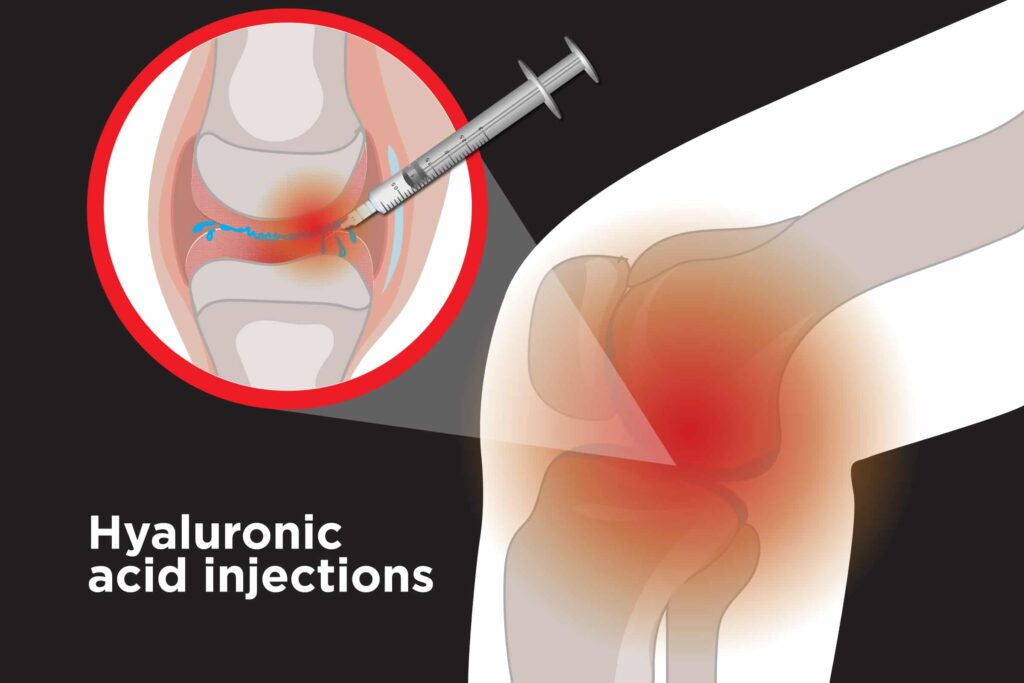
Hyaluronic acid injections, sometimes called knee gel injections or viscosupplementation, are a non-surgical treatment option for patients with knee osteoarthritis who are looking for an alternative to oral medication or surgery.
How Hyaluronic Acid Injections Work
Hyaluronic acid is a naturally occurring substance found in joint fluid, where it acts as a lubricant and shock absorber. In osteoarthritic knees, the joint fluid tends to break down and lose some of its natural cushioning ability. Hyaluronic acid injections are designed to supplement that fluid, with the goal of improving lubrication and reducing friction between joint surfaces during movement. The basics are covered in joint lubricant injections explained.
Treatment usually involves a series of injections directly into the knee joint, spaced roughly a week apart, though the exact protocol depends on the specific product used and your provider’s recommendation.
Who Might Be a Candidate
Hyaluronic acid injections are typically considered for patients with mild to moderate knee osteoarthritis who haven’t found enough relief from conservative measures like physical therapy, weight management, or over-the-counter pain relievers, and who want to explore options before considering knee replacement surgery. It’s not the right choice for every stage of osteoarthritis, which is why a knee evaluation and imaging review usually come first.
What the Research Shows
Research on hyaluronic acid injections for knee osteoarthritis is mixed. Some studies and patients report meaningful relief in pain and function for a period of months, while other research shows more modest benefit compared to a placebo. Because results vary by patient and by the severity of the arthritis, it’s generally presented as one option among several rather than a guaranteed fix, and it’s often used alongside physical therapy rather than in place of it.
What to Expect
The injection itself takes just a few minutes, and most patients return to normal activity the same day, with some providers recommending you avoid high-impact activity for a day or two afterward. The injections are generally well tolerated, and side effects like temporary swelling or soreness at the injection site are uncommon and typically resolve quickly.
Individual results vary, and hyaluronic acid injections are not guaranteed to eliminate knee pain. If you’re dealing with knee osteoarthritis and want to know whether this option makes sense for you, a pain management provider in Brooklyn can walk you through an evaluation.
Frequently asked questions
Can hyaluronic acid injections help a knee that is bone on bone?
Often less than in earlier arthritis. Viscosupplementation is generally aimed at mild to moderate osteoarthritis, where some joint surface remains, and end-stage arthritis tends to respond less predictably. It is not an absolute bar, and some people still try it while weighing other options, but imaging and an examination usually guide whether it is worth attempting.
Is a single-shot gel injection as effective as a three-shot course?
The evidence does not clearly favor either schedule. Single-dose and multi-dose products differ in the amount and formulation given rather than in a proven difference in results, so the choice often comes down to which product is being used, the cost, and how many visits are practical. A provider can explain which schedule is proposed and why.
Can both knees be injected at the same visit?
Usually yes, when both knees have arthritis that warrants treatment. Doing both at once saves a trip, though it makes it harder to judge which knee responded, and it leaves no comfortable leg to favor for the first day or two. Some providers prefer to treat one knee first for exactly that reason.
Are these injections a concern for people with egg or poultry allergies?
They can be, depending on the product. Some hyaluronic acid preparations are derived from rooster combs, while others are produced by bacterial fermentation and contain no avian material. Anyone with a known bird, feather or egg allergy should raise it beforehand, so a non-avian product can be chosen or the plan reconsidered.
Not sure which knee treatment actually fits?
An assessment says plainly which non-surgical options apply. More on knee pain.
Book an AssessmentServing Brooklyn, the Five Towns, and Monsey.


