

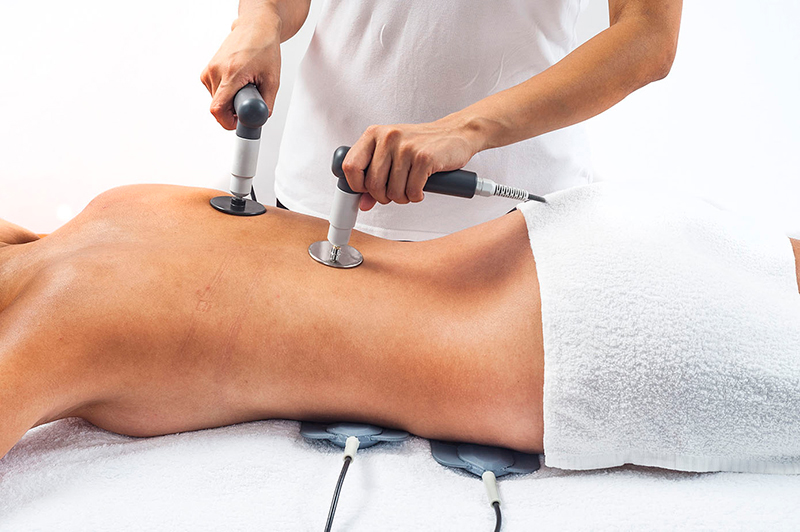
If you’re researching pain treatment options in Brooklyn, you may have come across TECAR therapy and wondered what it actually involves. TECAR stands for Transfer of Energy Capacitive and Resistive, a non-invasive treatment that uses radiofrequency energy to generate heat inside the body’s own tissue, rather than applying heat from the outside. A plain explanation of the technology is in TECAR therapy explained.
How TECAR Therapy Works
During a TECAR session, a handheld electrode is moved across the skin while a return electrode completes the circuit. The device delivers a radiofrequency current that passes through the tissue, and the body’s own resistance to that current generates heat at a cellular level. This is different from a heating pad or hot pack, which only warms the surface of the skin. Because the heat is generated deeper in the muscle, tendon, or joint tissue, TECAR is often used to target structures that are harder to reach with surface-level treatments.
Practitioners typically alternate between two modes: a capacitive mode, which is gentler and works well on more superficial soft tissue, and a resistive mode, which concentrates energy more precisely and is often used on denser tissue like tendons, ligaments, and areas closer to bone.
What TECAR Is Used For
TECAR therapy is commonly used as part of a broader treatment plan for muscle strains, tendon irritation, joint stiffness, and general chronic pain conditions. It’s frequently paired with physical therapy, since the increased blood flow and tissue temperature can make a joint or muscle group more receptive to stretching and strengthening work that follows. How it applies to chronic injury is set out in TECAR therapy for chronic injuries.
Patients who are looking for non-surgical, drug-free options, or who want to reduce their reliance on oral pain medication, often ask about TECAR as part of a multi-modal approach that may also include laser therapy, targeted injections, or manual therapy, depending on the diagnosis.
What to Expect During a Session
A typical TECAR session runs between fifteen and thirty minutes. Most patients describe the sensation as a comfortable, gradually building warmth rather than any kind of shock or discomfort. TECAR is generally well tolerated, and side effects are uncommon, though as with any treatment, your provider will review your history to confirm you’re a good candidate before starting.
Is TECAR Right for You?
TECAR isn’t a fit for every condition, and it works best as one part of a coordinated plan rather than a stand-alone fix. Individual results vary, and TECAR is not guaranteed to eliminate pain on its own. The best way to know whether it makes sense for your specific situation is a proper evaluation with a provider who can look at your full history and current symptoms.
If you’re in Brooklyn and want to talk through whether TECAR therapy fits your treatment plan, a pain management provider can walk you through the available options.
Frequently asked questions
Can TECAR be used over a metal implant or a joint replacement?
Not without checking first. TECAR passes a radiofrequency current through tissue, and metal implants, pacemakers and other electronic devices change how that energy behaves, so they are screened for beforehand. Some situations rule the treatment out entirely, while others only change where the electrodes are placed, which is a decision for the provider.
Can TECAR be used on the neck or close to the head?
The neck is treated in some plans, but the closer the area is to the head, the more cautious the setup becomes. Treatment over the eyes, the front of the throat and directly over the skull is generally avoided, and settings are kept lower in that region. Anyone with an implanted device in the head or neck is screened first.
Can TECAR burn the skin?
It should not. The device is designed to produce heat within the tissue rather than at the surface, and the electrode is kept moving with a conductive cream, which is why the sensation is a building warmth rather than a hot spot. Saying immediately if any point feels sharp or too hot keeps the setting in a safe range.
Is TECAR safe when an area feels numb or has reduced sensation?
It calls for extra caution. Heat-based treatment relies partly on the person reporting when warmth becomes too much, and that warning is missing where sensation is reduced by nerve damage, diabetes-related neuropathy or scarring. Lower settings, shorter times, or a treatment that does not depend on heat may be chosen instead after assessment.
Wondering whether TECAR therapy applies to your pain?
A physician-led evaluation finds the driver first, then matches the treatment. More on TECAR therapy.
Book an AssessmentServing Brooklyn, the Five Towns, and Monsey.


