
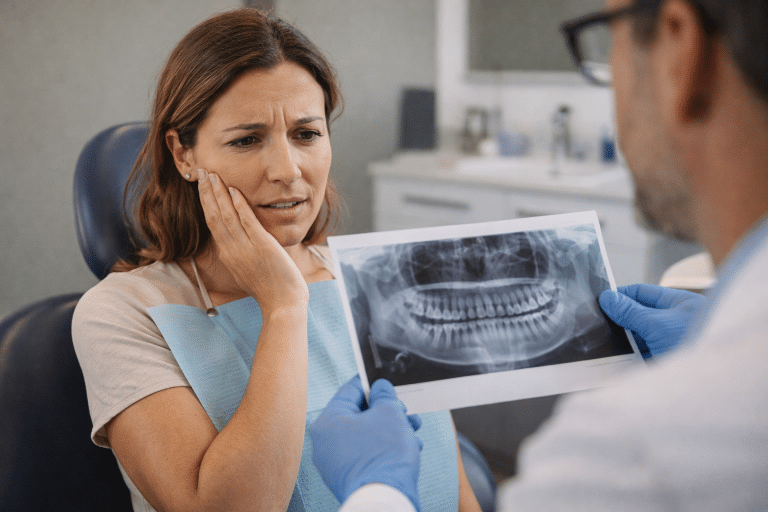
There is a quiet progression happening inside the jaws of millions of Americans right now. It begins with something barely noticeable—a faint click when chewing, a subtle tightness along the jawline after a stressful workday, or a dull ache behind the ear that disappears by mid-morning. These early TMJ symptoms are so easy to dismiss that most patients do exactly that. They assume it is stress. They assume it will resolve on its own. They wait.
And then, one morning, they wake up and realize their teeth no longer fit together the way they once did.
By the time a permanent bite shift occurs, the temporomandibular joint has already undergone significant structural and functional change. What started as a minor inconvenience has quietly reorganized how the jaw moves, how the muscles fire, and how the upper and lower teeth make contact. The tragedy is not that these changes are inevitable—it is that they are almost always preceded by warning signs that went unrecognized or were actively ignored.
This article is written for the patient who suspects something is wrong with their jaw but has been told to “just relax” or “stop clenching.” It is written for the person who has already searched for a TMJ specialist near me and is trying to understand what they are actually dealing with before scheduling an appointment. And it is written with the clinical experience of a Brooklyn-based pain management practice that treats TMJ/TMD without drugs, opioids, injections, or surgery—using advanced laser therapy, myofascial rehabilitation, and neuromuscular re-education to address the root cause of jaw dysfunction.
If you are experiencing any of the symptoms described below, do not wait for a bite shift to confirm what your body has been trying to tell you for months.
Why TMJ Symptoms Are So Easy to Misidentify
The temporomandibular joint is one of the most biomechanically complex joints in the human body. It slides, rotates, and hinges simultaneously during every chewing cycle, every yawn, and every spoken word. Because it operates continuously throughout the day—and because it is so closely linked to the cervical spine, the muscles of the face and skull, and even the muscles of the upper back—TMJ symptoms rarely present as isolated jaw pain.
Instead, they disguise themselves.
Patients frequently report headaches that begin at the temples or wrap around the skull. They report ear fullness or ringing that mimics an ear infection. They describe neck stiffness that physical therapy cannot seem to resolve. They notice that their front teeth no longer touch when they bite down, or that one side of their jaw feels “heavier” than the other. Each of these presentations is a legitimate TMJ symptom, yet none of them immediately suggests a jaw problem to the average patient—or, unfortunately, to many general practitioners.
This is precisely why so many cases of TMJ/TMD go undiagnosed until the dysfunction has progressed to a stage where structural compensation has already occurred. The jaw does not simply fail one day without warning. It sends signals—sometimes for years—before the damage becomes irreversible.
The Click That Everyone Ignores
Joint clicking is perhaps the most universally dismissed TMJ symptom. Patients hear a pop or click when opening their mouth wide, and because it is painless, they assume it is harmless. In many cases, that click represents an anterior displacement of the articular disc—the small cushion of cartilage that sits between the condyle of the mandible and the temporal bone of the skull.
When the disc is displaced, the click occurs as it snaps back into position during mouth opening. Over time, however, the disc can become permanently displaced. When this happens, the click may actually disappear—not because the joint has healed, but because the disc is no longer recapturing at all. This is the transition from a reducing disc displacement to a non-reducing disc displacement, and it often coincides with a sudden limitation in mouth opening and a noticeable change in how the teeth align.
Patients who previously had a “harmless click” now have a jaw that will not open fully and a bite that feels fundamentally different. This progression is common, well-documented, and almost entirely preventable with early intervention from a qualified TMJ specialist.
Clenching-Related Pain That Masquerades as Tension
Another category of TMJ symptoms that patients routinely dismiss is muscle pain caused by chronic clenching or bruxism. Many individuals clench their teeth during sleep without any awareness that they are doing so. The resulting pain manifests not as jaw soreness but as tension headaches, facial fatigue, neck stiffness, and even shoulder tightness.
This is because the masseter and temporalis muscles—the primary muscles of mastication—are deeply connected to the cervical and upper thoracic musculature. When these muscles are chronically overloaded by nocturnal clenching or daytime jaw bracing, the entire head-neck-jaw system becomes involved. Patients may seek treatment for their headaches or their neck pain without ever realizing that the jaw is the primary driver of their symptoms.
In clinical practice, this is one of the most important diagnostic distinctions to make. Treating the neck alone will not resolve symptoms that originate from jaw muscle overload. Treating headaches with medication will not address the clenching pattern that produces them. Effective TMJ treatment requires identifying all of the contributing factors and addressing them in a coordinated, layered approach.
Morning Jaw Stiffness and Restricted Opening
A third symptom that patients consistently underestimate is morning jaw stiffness. They wake up and notice that their jaw feels tight, that it takes a moment to “loosen up” before they can eat breakfast comfortably. They attribute it to sleeping in an awkward position or to general stress.
In reality, morning stiffness in the jaw is frequently a sign of sustained nocturnal clenching, which produces inflammation within the joint capsule and fatigue in the surrounding muscles. Over weeks and months, this repeated inflammatory cycle leads to progressive stiffness, reduced range of motion, and subtle changes in how the mandible tracks during opening and closing.
When left unaddressed, the cumulative effect of this nightly overload is a jaw that becomes increasingly restricted and a bite that gradually shifts as the joint structures adapt to their new, dysfunctional baseline. By the time a patient seeks care, they have often lost meaningful range of motion and require a more intensive course of treatment than would have been necessary had they sought evaluation at the first sign of morning stiffness.
How a Bite Shift Happens—and Why It Becomes Permanent
A bite shift does not occur overnight. It is the end result of a series of compensatory changes that accumulate over time as the temporomandibular joint and its surrounding structures adapt to dysfunction.
The sequence typically unfolds as follows. Chronic muscle overload or disc displacement alters the position of the mandibular condyle within the joint. As the condyle shifts—even by fractions of a millimeter—the way the upper and lower teeth meet changes accordingly. The body then attempts to compensate by adjusting muscle recruitment patterns, altering chewing mechanics, and gradually wearing tooth surfaces unevenly. Over time, these compensations become self-reinforcing. The muscles adapt to their new lengths, the joint surfaces remodel, and the bite settles into a position that no longer matches the patient’s original occlusion.
Once this remodeling has occurred, simply relaxing the muscles or reducing inflammation is no longer sufficient to restore the original bite. The structural changes have become the new normal, and reversing them requires a far more complex clinical intervention than would have been necessary at an earlier stage.
This is why early evaluation is so critical. When a patient presents with clicking, clenching-related pain, or morning stiffness—before structural remodeling has occurred—TMJ treatment can focus on calming the irritated tissues, restoring normal muscle function, and correcting the mechanical patterns that are driving the dysfunction. The joint can be preserved. The bite can be protected.
The Role of the Cervical Spine in TMJ Progression
One factor that is frequently overlooked in TMJ care is the role of the cervical spine. The upper cervical vertebrae share muscular and neurological connections with the jaw, and dysfunction in one region almost invariably affects the other. Forward head posture, upper thoracic stiffness, and poor cervical stability all increase the mechanical load on the temporomandibular joint and perpetuate the muscle overload patterns that drive TMJ symptoms.
This is why a comprehensive approach to TMJ treatment must address the entire head-neck-jaw system rather than focusing on the jaw in isolation. In a medication-free, technology-forward clinical setting, this means combining targeted laser therapy for the jaw musculature and periarticular tissues with cervical spine mobilization, upper thoracic mechanics support, and neuromuscular re-education for the muscles that control jaw position and movement.
Laser therapy—specifically photobiomodulation and, where clinically appropriate, high-intensity laser protocols—serves as the cornerstone of this approach. It provides effective pain modulation and inflammation reduction without drugs, allows for precise targeting of the masseter, temporalis, and cervical paraspinal muscles, and supports tissue recovery in a way that accelerates the body’s natural healing processes. When layered with myofascial release, bite and clench habit reversal strategies, and breathing and downregulation protocols, this integrated model delivers durable relief that addresses the root causes of TMJ dysfunction rather than merely suppressing the symptoms.
For patients searching for a TMJ specialist near me in Brooklyn or greater New York City, understanding what a thorough evaluation entails is an important first step. A comprehensive TMJ evaluation should include a detailed assessment of jaw range of motion, joint sounds, muscle tenderness, cervical spine mechanics, and bite alignment. It should identify the specific pain generators involved—whether myofascial, joint-driven, neuropathic, or a combination—and map the perpetuating factors that are keeping the dysfunction active.
In a medication-free practice, the goal of this evaluation is not to prescribe a muscle relaxant or recommend an invasive procedure. It is to build a clear clinical picture of what is happening in the head-neck-jaw system, determine the phase of dysfunction the patient is in, and design a targeted, layered treatment plan that moves through three distinct phases.
The first phase focuses on calming the irritated tissues, reducing protective muscle guarding, and improving pain tolerance—including sleep tolerance, which is frequently disrupted in TMJ patients. The second phase addresses mobility restrictions, myofascial adhesions, and joint mechanics to restore normal movement patterns. The third phase rebuilds muscular endurance, motor control, and load tolerance so that the jaw can function under normal daily demands without relapsing into dysfunction.
This phased, structured approach ensures that treatment progresses at a pace the body can sustain, that gains are consolidated before moving to the next level of complexity, and that the patient is equipped with the self-management skills necessary to maintain their improvements long after treatment has concluded.
Article Summary
TMJ symptoms such as jaw clicking, clenching-related headaches, morning stiffness, ear fullness, and subtle changes in bite alignment are among the most commonly dismissed warning signs in clinical practice. Left unaddressed, these symptoms can progress through a predictable sequence of disc displacement, muscle overload, and joint remodeling that ultimately results in a permanent bite shift. Early evaluation by a qualified TMJ specialist is essential to interrupt this progression before structural changes become irreversible. Non-surgical, drug-free TMJ treatment using advanced laser therapy, myofascial rehabilitation, cervical spine support, and neuromuscular re-education offers a comprehensive, root-cause approach to restoring jaw function and protecting long-term bite stability. For patients in Brooklyn, New York City, seeking a TMJ specialist near me, a technology-forward, medication-free practice provides the diagnostic precision and layered treatment planning necessary to address TMJ dysfunction at its source—before a temporary symptom becomes a permanent problem.