

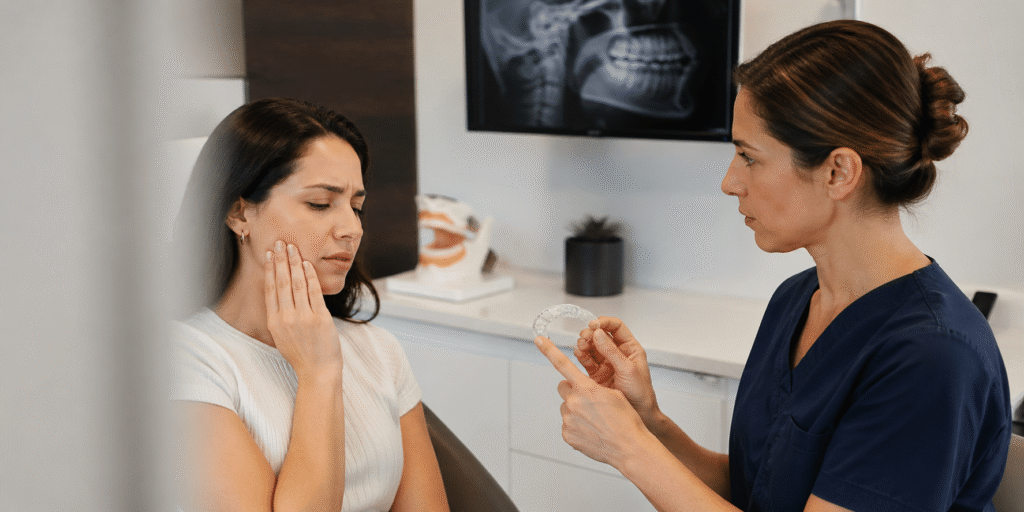
A patient from Boerum Hill described her morning routine to me with quiet exhaustion. She would wake up, brace herself, and try to take a single bite of toast. If the bite went well, she would risk a second. If the joint hurt, she would shift to yogurt and skip breakfast. By dinner, after a day of careful chewing on the unaffected side, the entire jaw would ache from compensation. She had been eating this way for nearly two years. Three previous providers had given her advice that sounded reasonable in the moment: switch to a soft diet, use ice, take anti-inflammatories as needed, try this stretch. None of it had stabilized her chewing function. The pain was always one bite away.
After two decades of treating jaw disorders in Brooklyn, I can tell you that pain with chewing is one of the most under-treated TMJ presentations. Patients hear endless advice about avoiding hard foods, but very little about how to actually stabilize the joint and the muscles so that chewing becomes possible again. The standard recommendations address the symptom (do not chew the food that hurts) without addressing the dysfunction (why chewing hurts in the first place). Real, durable relief depends on stabilizing steps that most providers skip; once those steps are in place, the question of how to help with TMJ pain ceases to be theoretical and becomes something the patient can finally feel at the dinner table.
Why standard chewing pain advice falls short
When patients ask what causes TMJ pain to flare, specifically with chewing, the answer involves several systems working together under load. Chewing is one of the most demanding things the temporomandibular joint does. Each bite generates significant force across the joint surfaces, recruits all four masticatory muscles in coordinated sequence, and depends on a stable cervical spine to hold the head while the jaw works. When any link in that chain is dysfunctional, the chewing motion becomes the moment the dysfunction announces itself.
The standard advice patients receive for chewing pain typically includes:
- Switch to a soft diet
- Avoid chewing gum and tough foods
- Cut food into small pieces
- Take an anti-inflammatory if needed
- Try ice or heat for symptomatic relief
This advice is not wrong. It simply is not enough. A soft diet temporarily reduces the load on a dysfunctional joint without addressing what made the joint dysfunctional. Anti-inflammatories mask the inflammatory response without changing what generated it. Ice and heat provide brief comfort without altering the mechanics. After weeks or months of following this advice, patients find themselves exactly where they started, except now they have built a daily life around avoiding their own teeth.
Stabilizing the joint and the muscles enough to restore comfortable chewing requires a different kind of work. It requires actually fixing the structures that are failing under load, not simply reducing the load until they fail less obviously. The steps below are the ones I have consistently seen produce real results for patients who had given up on eating normally.
Step one: deload the joint while it heals
The first stabilizing step is mechanical. A joint that hurts when chewing is under too much compressive load for its current state of health. Before any healing work can be effective, the load needs to come down. This is where a properly designed custom orthotic earns its place in the plan, and where most providers skip the most important detail.
A generic night guard, the kind dispensed by many general dental offices, prevents tooth wear from clenching but does little to deload the joint itself. A purposeful orthotic, designed after a complete diagnostic workup, sets the bite at a specific vertical dimension to reduce compressive forces on the joint surfaces. It can also be designed for daytime use during the most painful weeks of recovery, a period that patients with chewing pain often need. The same patient who got minimal benefit from three previous night guards often experiences substantial improvement on one well-designed appliance because the design was actually engineered to deload the joint rather than protect the teeth.
Cervical spine work is the partner step that almost no one performs. A forward head posture or a stiff upper cervical spine places a continuous load on the TMJ throughout the day, undermining whatever the orthotic accomplishes. Without addressing the cervical contribution, the joint remains compressed by the head’s position, even with the orthotic in place. Stabilization requires both layers, not just one.
Step two: calm the inflammation that makes every bite hurt
Once the load is reduced, the next stabilizing step targets the inflammatory response inside the joint and the surrounding tissues. Chewing pain that is not addressed at this layer will keep recurring, no matter how careful the patient is with food choices.
Anti-inflammatory technology that works at the tissue level, rather than masking symptoms systemically, is the cornerstone of this step. Low-level laser therapy, also called photobiomodulation, reduces inflammation at the cellular level by improving mitochondrial function in the joint capsule, the disc, and the surrounding muscles. High-intensity laser therapy reaches deeper tissues for joints with significant intracapsular inflammation. Both produce measurable reductions in chewing pain within the first several sessions when the protocol is delivered correctly.
For inflammation that has progressed to active synovitis or has produced visible joint effusion on imaging, regenerative options become valuable. For chronic inflammation associated with ligamentous laxity around the joint, prolotherapy can stabilize the supporting structures and reduce mechanical irritation that perpetuates the inflammatory cycle.
This is the step where many patients first feel a substantial change. The morning bite of toast that has been frightening for months becomes possible again. The pain that previously appeared with the third bite now does not appear until the tenth, then the twentieth, then not at all. That progression is the signal that the inflammation is genuinely calming, not simply being avoided.
Step three: stabilize the muscles that drive the chewing motion
Chewing is a muscular act. Even with a calm joint and reduced load, chewing pain persists if the masticatory muscles are dysfunctional. The third stabilizing step addresses the muscles directly through a combination of techniques most patients have never received in coordinated form.
Trigger point work matters first. The masseter, temporalis, lateral pterygoid, and medial pterygoid all develop hyperirritable spots that refer pain into the teeth, the jaw, the ear, and the temple during chewing. Externally palpable trigger points are released through manual technique. Intraoral trigger points, particularly in the lateral and medial pterygoid muscles, require the gloved-finger technique that most providers do not perform. When these are deactivated, chewing becomes dramatically more comfortable, sometimes within a single session of skilled work.
Extracorporeal Shockwave Therapy (ESWT) is added when trigger points and chronic spasm refuse to release with manual work alone. ESWT delivers controlled mechanical energy that breaks the spasm cycle in chronically tight muscles that have effectively stopped healing on their own. For patients with years of accumulated muscle dysfunction, this approach often produces relief that manual techniques alone could not achieve.
Neuromuscular re-education is the step that converts muscle release into durable change. Patients learn how their jaw muscles should fire during chewing, retrain coordinated activation patterns, and replace compensatory habits such as one-sided chewing, premature recruitment of the temporalis, and substitution of the cervical and hyoid muscles. Without this retraining, the released muscles return to their old patterns within weeks. With it, the muscles maintain their corrected function long after active treatment ends.
The compensations that quietly sabotage stabilization
After months or years of chewing pain, every patient develops compensatory patterns that feel automatic but actively work against stabilization. The most common ones include unilateral chewing on the unaffected side, which overloads that joint and creates a second problem within months; reduced jaw opening to avoid the painful range, which causes the muscles to forget how to coordinate full motion; tongue and swallowing pattern changes, where the tongue stops resting properly against the palate and abnormal swallowing develops as a workaround; subtle posture shifts, where the head tilts toward the painful side to take pressure off the joint, gradually fixing the cervical spine into a new abnormal position; and chronic low-grade clenching during meals as the masseter stays partially engaged in anticipation of pain. Identifying and correcting these compensations is essential to lasting recovery. Without it, even successful pain reduction tends to relapse because the body has built habits around the original dysfunction. A serious TMJ specialist, Brooklyn or TMJ specialist, New York patients can rely on, will look for these compensations during evaluation and address them throughout treatment, not as an afterthought.
How to stop TMJ pain at the dinner table, not just in the office
The real test of any TMJ care is not whether pain reduces during a treatment session. It is whether the patient can sit down to a normal meal weeks later and chew without thinking about it. Reaching that point requires the stabilizing steps above to be sequenced correctly and reinforced through specific in-life practices that protect the recovery as it consolidates.
Knowing how to stop TMJ pain during chewing in your daily life starts with chewing bilaterally once tolerable. The single most important habit to rebuild is alternating sides, deliberately, even when the unaffected side feels easier. This restores symmetric muscle function and prevents the secondary dysfunction that unilateral chewing reliably produces. Patients are often surprised at how clumsy bilateral chewing feels initially. That clumsiness is the muscles relearning what they had stopped doing.
Food progression matters too. Once the joint and muscles have stabilized through phases one through three, food texture is gradually reintroduced rather than avoided indefinitely. A patient who has been living on yogurt and smoothies for 12 months loses jaw function in the same way that bed rest causes muscles elsewhere in the body to atrophy. Carefully graded reintroduction of texture, starting with soft solids and progressing toward firmer foods over weeks, retrains the chewing system in a way no exercise alone can accomplish. The food itself becomes the rehabilitation.
Posture during meals quietly determines how much load reaches the joint with every bite. Patients who eat hunched over a phone or a laptop add cervical compression that translates directly into TMJ load. Eating with the head over the shoulders rather than forward can reduce chewing pain by a meaningful margin, even before any other intervention takes effect. This is one of the simplest, most overlooked tools available to a patient working on stabilization.
When chewing pain has been part of a patient’s life for many months or years, the path to genuine relief is rarely a single appointment with a single provider. It is coordinated, drug-free, non-surgical therapy for TMJ pain that addresses every stabilizing layer in proper order. Patients who have been searching for help with a TMJ disorder near me should look for a clinician who actively performs the stabilizing steps most providers skip, not one who repeats the standard chewing-avoidance advice that has already failed.
I have treated patients in Brooklyn Heights, Mill Basin, Gravesend, and Sheepshead Bay whose chewing pain had quietly reorganized their entire lives, and who finally returned to comfortable meals once the stabilizing work was performed in the right sequence. Their relief was not magic. It was mechanics, inflammation, muscles, and habits, addressed in the right order with the right tools. If you have been eating around your jaw for too long, please understand that the soft-diet advice you have been following is not the answer. The answer is stabilization, and it is genuinely available to you. The first comfortable bite of real food, after months of careful avoidance, is one of the most quietly powerful experiences in TMJ care, and there is a real path to getting you there.
Article summary
Standard advice for TMJ chewing pain (soft diet, food avoidance, anti-inflammatories, ice, and heat) reduces symptoms without stabilizing the underlying dysfunction, which is why pain returns the moment normal eating resumes. Real stabilization moves through three coordinated steps: deloading the joint through a purposefully designed custom orthotic and cervical spine integration; calming inflammation through low-level and high-intensity laser therapy, and prolotherapy where indicated; and stabilizing the muscles through trigger point work, ESWT, and neuromuscular re-education. Recovery is reinforced by correcting compensations such as unilateral chewing, reduced opening, abnormal swallowing, and forward head posture. Done in the right sequence, this approach restores comfortable chewing rather than perpetually working around it.
Frequently asked questions
Why does the jaw ache more by the end of the day than first thing in the morning?
Daytime aching usually reflects accumulated load rather than a separate problem. Every bite, conversation and swallow adds work, and a jaw that is guarding spreads that work to the opposite side and the neck. By evening the compensating muscles are fatigued and sore even if the joint itself started the day quiet. Pain that is worst on waking points more toward night-time clenching.
Is chewing only on the good side making the problem worse?
Over time, usually yes. One-sided chewing overloads the working side muscles and leaves the painful side stiff and deconditioned, so the imbalance grows. Short-term protection during a flare is reasonable, but months of it tends to create a second problem. Reintroducing gentle, even chewing as symptoms allow is generally part of a rehabilitation plan rather than something to postpone indefinitely.
Which foods are reasonable to add back first as chewing gets easier?
Softer proteins and cooked vegetables that need a few controlled chews usually come first, then breads, then firmer raw foods. The useful test is whether a food can be chewed evenly on both sides without provoking pain that lingers afterwards. Very chewy items such as bagels, steak and gum are typically last to return, and some people leave them out long term.
Can a jaw orthotic be worn while eating meals?
Most appliances are removed for meals, since eating with one in place changes how the teeth meet and can add load rather than reduce it. Some daytime designs are worn between meals during the worst weeks and taken out to eat. The instruction depends on the specific appliance, so the wearing schedule should come from whoever designed and fitted it.
Does a long soft diet weaken the jaw muscles?
Prolonged soft eating can leave the chewing muscles deconditioned and the joint less tolerant of normal loads, which is one reason a soft diet works better as a short phase than a permanent habit. Strength and coordination usually return gradually once chewing is reintroduced in controlled steps. Being unable to tolerate normal food after several weeks calls for reassessment rather than a softer menu.
Still looking for what is actually driving your jaw pain?
A physician-led evaluation looks at the jaw, neck and bite together. More on TMJ therapy and TMJ pain.
Serving Brooklyn, the Five Towns, and Monsey.


